
At RunX we can help you with an analysis to look at possible causes of Piriformis syndrome.
Piriformis syndrome
How do I recognize piriformis syndrome?
For some time now I have been feeling a dull pain in the upper part deep in my gluteal muscle. When walking I feel a loss of strength in my leg and after walking I am very stiff. I am unable to lean forward with my legs straight. The knee then automatically bends slightly. I am also hindered in my daily activities by a nagging pain. Sitting for long periods of time increases the pain enormously and every car ride is agony.
The above pain fits well with a complaint known as piriformis syndrome, also called “thick wallet syndrome”. Sitting on a wallet that is too thick for a long time can also be a cause (in my case it was really the training)!

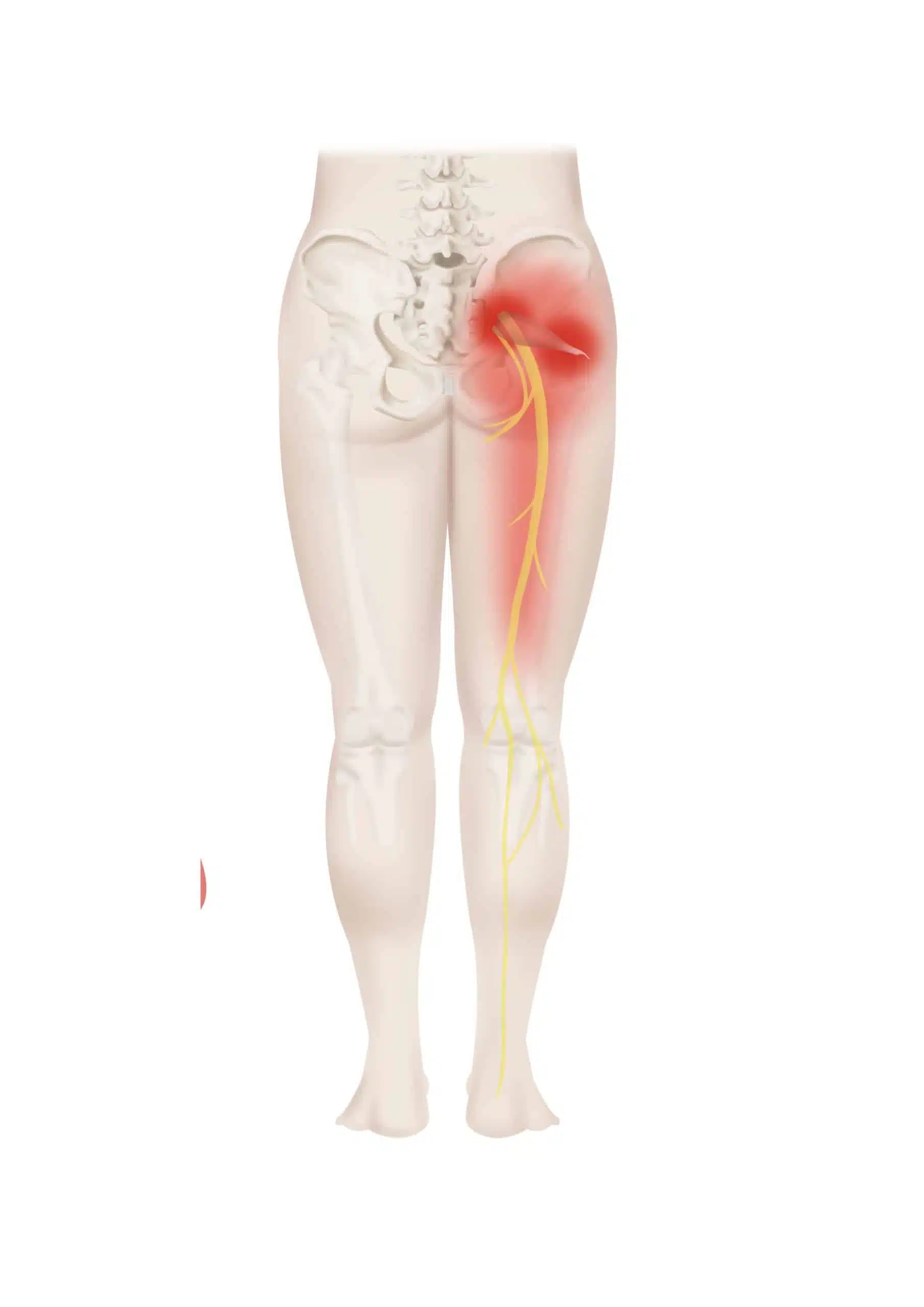
Symptoms of piriformis syndrome
People with piriformis syndrome often complain of a dull pain in the deep upper part of the buttock. Sitting for a long time is painful and leaning forward with straight legs can also trigger the pain. Often there is radiation to the leg/hamstrings and there is loss of strength. Running generally worsens the complaint, but sitting in the same position for a long time (car) can also trigger the complaint.
The complaint has many characteristics of sciatica, but here the underlying cause lies in the back. In both cases, it is the same nerve that is acting up. Making a good diagnosis is therefore not always easy, not even for the physiotherapist. In the case of piriformis syndrome, the exercises I have described generally have quick results. Be careful not to push through the pain. Perform the exercises in a controlled manner.
Number of possible causes
- The complaint can occur after trauma, such as a blow, bump or fall on the buttock
- Old or worn out shoes
- Instability shoes
- Lack of damping
- The excessive inward rotation of the thigh
- Poor core stability
- Too much hip drop (pelvis sinks too much to the left while the right leg is in contact with the ground or vice versa)
- Too big steps
- Hallux valgus (crooked big toe)
- Overpronation
- Poor training structure
- Lack of flexibility
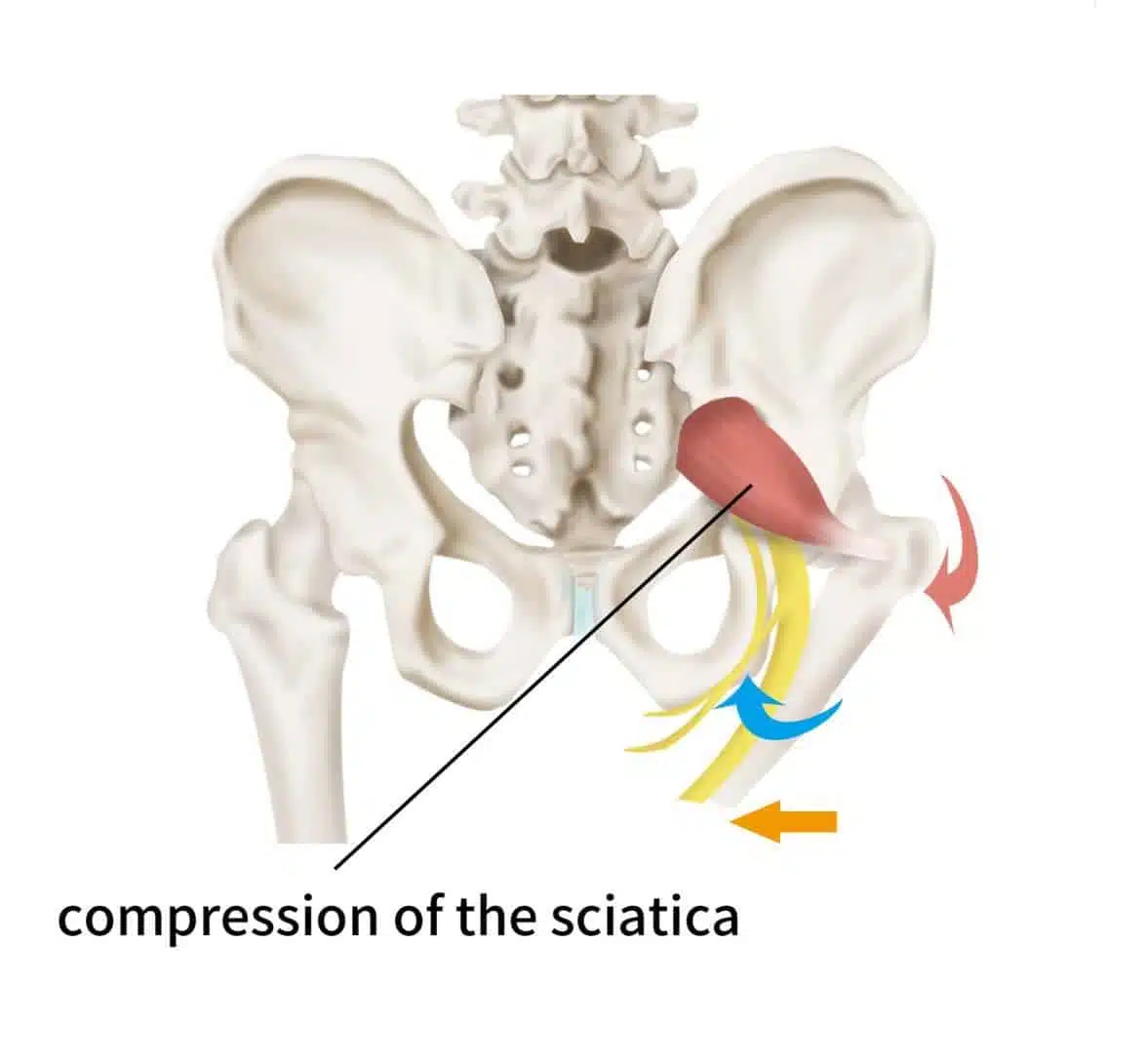
The picture on the right clearly shows that movements of your upper leg affect the piriformis and can therefore cause stress. The piriformis is constantly tense and presses against the nerve path (colored yellow in the drawing)

What are you doing about it?
First of all, you are looking for the right diagnosis. The nerve can also be irritated by back problems such as a hernia. Of course, you have to rule this out!
In the case of piriformis syndrome, you can visit a physiotherapist, but you can also take action yourself. As mentioned, the complaint is probably caused by a lack of strength and the resulting tension on the muscle. It is therefore important that you remove the tension and increase the strength. The exercises described below show you how to proceed.
Exercises
Kracht
For the following exercise you will need an elastic band.
Starting position: lie on your back with your knees pulled up. Place the elastic band around your knees and place your feet hip-width apart, pushing your knees outwards. You will now feel tension on the piriformis, among other things.
While you are lying like this, first lift your tailbone off the ground, now slowly come up vertebra by vertebra until only your shoulders are touching the ground. Then slowly return to the starting position in the same way. Make sure that you keep pushing your knees outwards. Repeat this in 3 sets of 10 repetitions.
Racking
Sit on the floor and lean with your arms stretched out behind you on the floor. From this position, place your right ankle on your left knee. While doing this, stretch your back and push your right knee outwards. Feel the stretch in your right buttock. Hold this stretch for 60 seconds. Then do the same exercise with the other leg.
Ruud Vlutters
Sports Podiatrist A/B
Trainer Coach B
Co-owner RunX Twente
Trigger point
In the following exercise you use a hard ball, such as a hockey ball or baseball.
Place the ball on the ground. Then, while supporting yourself on your arms, slowly lower yourself onto the ball with the affected area. Find the pain and make a rotating movement on the painful spot. Do this for about 60 seconds. This exercise gives the affected area a strong stimulus and increases blood flow. This promotes recovery.
RunX stands for skilled
en in person advice
RunX is the running specialty store for every type of athlete. Starting to run? Then you've come to the right place!